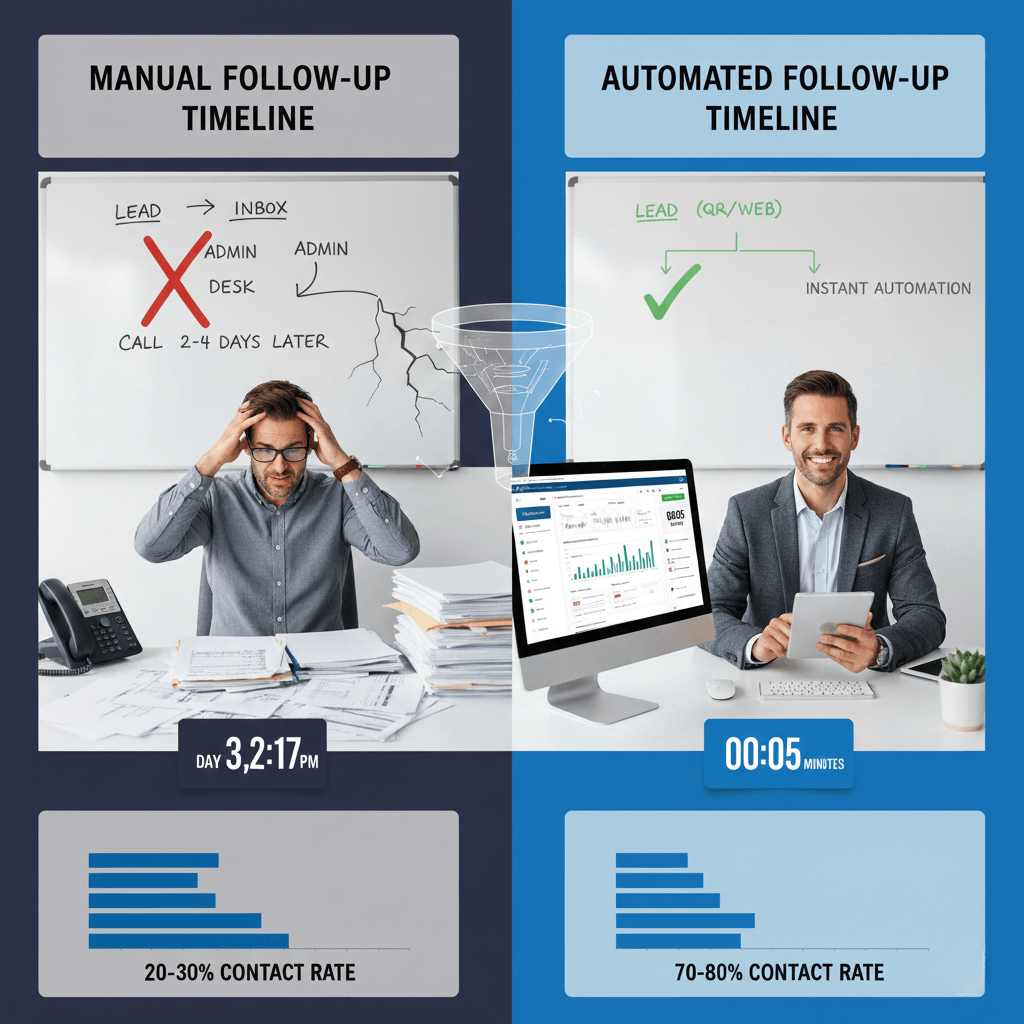
If you audit the marketing spend of the average financial advisory firm, you will usually find healthy budgets allocated to seminars, dinner workshops, LinkedIn ads, and referral programs.
Yet, if you follow the lifecycle of the leads generated from those investments, the data reveals an uncomfortable truth: Approximately 70% of generated leads never make it to a second conversation.
They aren't saying "no." They are simply vanishing into an operational black hole.
For COOs and firm owners, this isn't just a marketing failure; it is a revenue leakage crisis. The problem rarely lies in the quality of the lead, but rather in the friction of the follow-up process.
In an industry built on trust and relationships, the firms winning the greatest market share today aren't necessarily the ones with the best investment strategies—they are the ones with the best financial advisor automation systems.
Here is why lead leakage happens and the operational framework required to fix it.
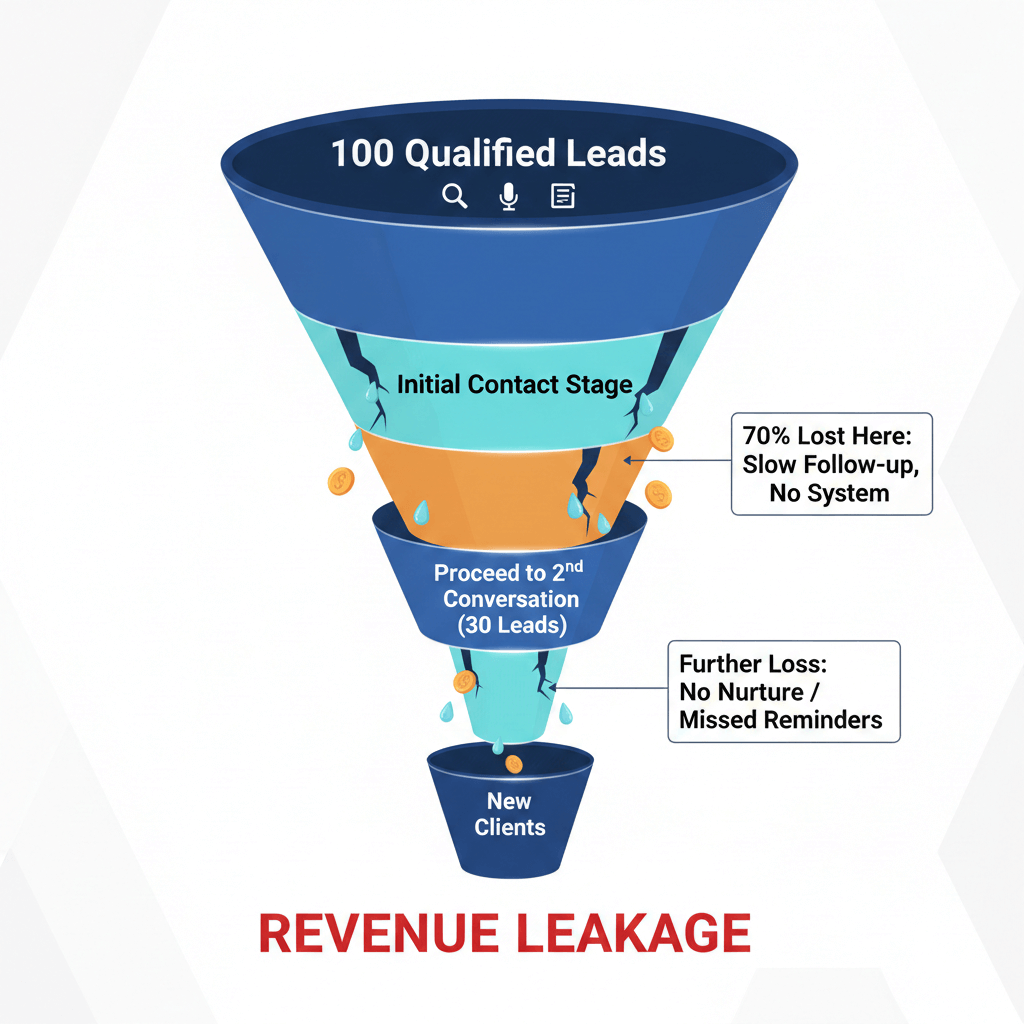
Why do qualified prospects go dark? It is rarely because they found another advisor immediately. It is usually because the firm’s response time and follow-up cadence failed to meet modern consumer expectations.
Here are the primary operational points of failure in advisor lead management:
Data consistently shows that if you do not contact a lead within the first 5 to 15 minutes, your chances of qualifying them drop by 400%.
Statistics show it takes 5 to 12 touchpoints to book an appointment with a cold lead.
Email open rates in the financial sector hover around 20%. If you are only emailing, 80% of your leads aren't even seeing your message.
Dinner seminars remain a staple of advisor marketing. However, the transition from paper evaluation forms to digital CRM entries is a bottleneck.
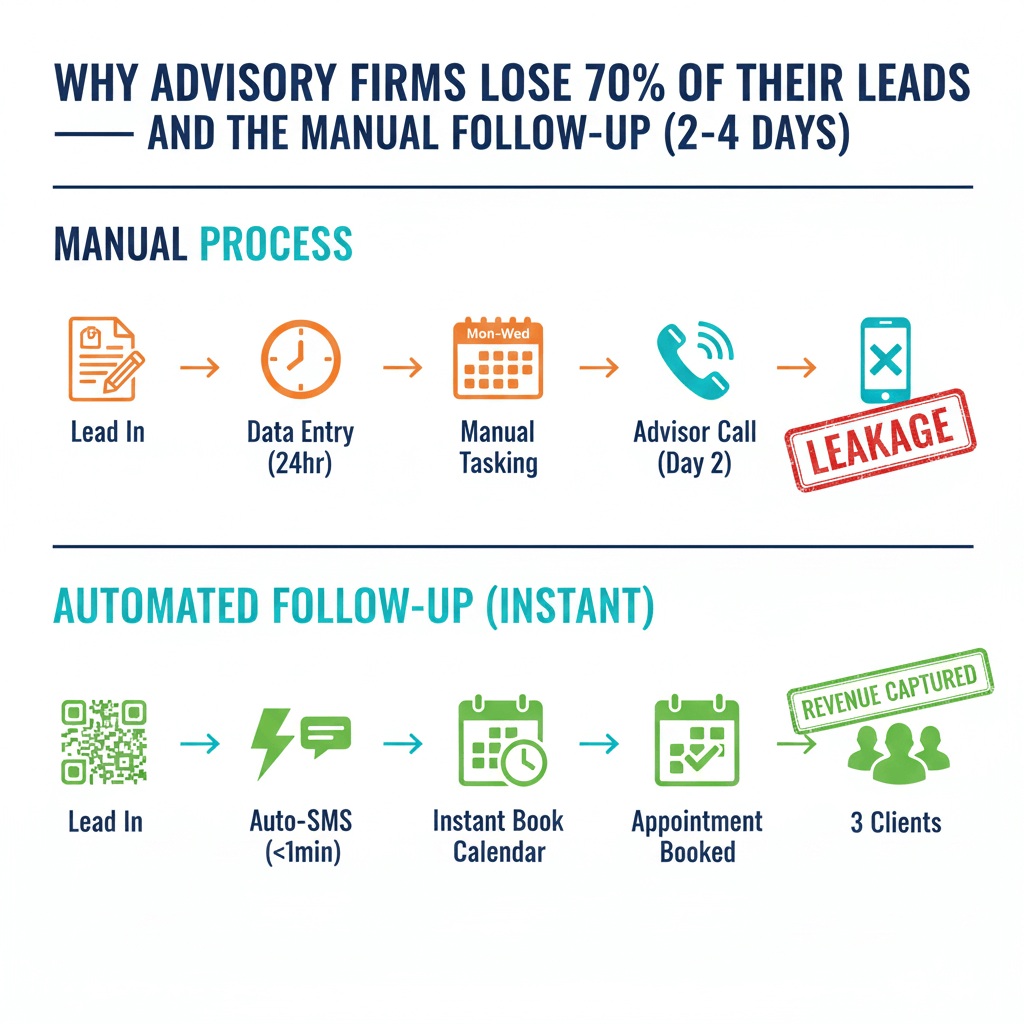
Let’s quantify this operational inefficiency.
Imagine a firm runs a comprehensive marketing campaign (seminars + digital ads) that generates 100 qualified leads.
The "Standard" Manual Scenario:
The Automated Scenario:
The Impact: If your average client brings in $10,000 in annual recurring revenue (on roughly $1M AUM), the manual process yields $30,000/year. The automated process yields $75,000/year.
Across a full year of marketing, the lack of an advisor follow-up system is costing the firm hundreds of thousands of dollars in recurrent revenue.
To plug this leak, firms cannot simply hire more junior advisors to make calls. You cannot solve a process problem with headcount; you must solve it with systems.
A robust advisor CRM and automation ecosystem must handle the heavy lifting before a human advisor ever picks up the phone.
Monday Morning: The marketing manager hands a stack of 40 evaluation forms from Thursday’s seminar to the admin. The admin spends 3 hours typing them into the CRM. By 2:00 PM, the leads are assigned to advisors. The advisors, busy with client reviews, call the leads on Tuesday. Most go to voicemail. Two weeks later, 35 of the 40 leads have been forgotten in the shuffle.
Thursday Night (At the Seminar): Attendees scan a QR code or fill out a digital form. Thursday, 8:15 PM: The system automatically tags the attendees. Those who requested a meeting instantly receive an SMS: "Hi John, great meeting you at the retirement workshop. Here is the link to grab that 15-minute slot we discussed." Friday Morning: The advisor logs in to find 8 appointments already booked on their calendar. The remaining 32 leads are automatically placed into a "Warm Nurture" email and SMS sequence. Result: Zero admin data entry. Zero leads lost to delay.
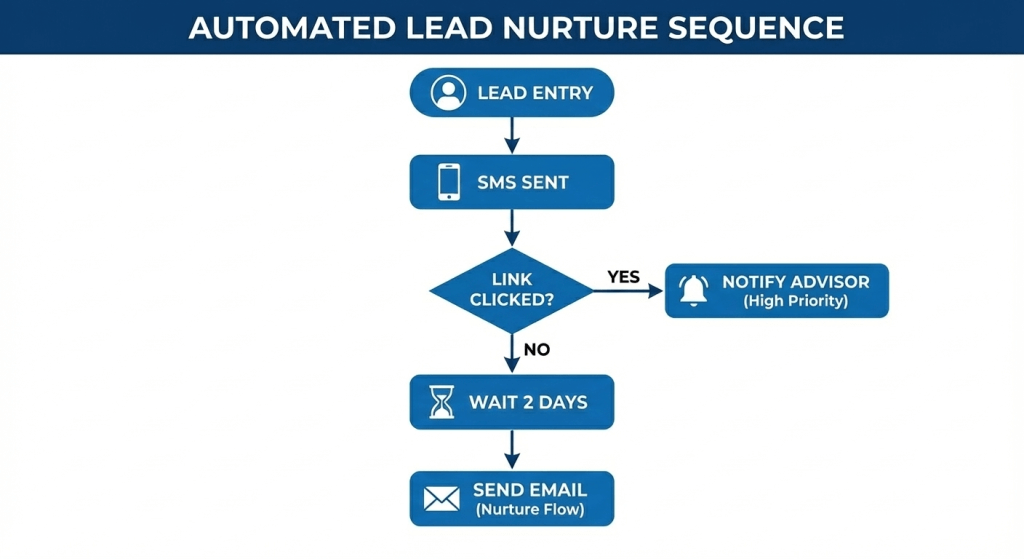
While many CRMs exist, few are built specifically for the high-touch, compliance-heavy world of financial advice. This is where LeadCenter functions not just as a tool, but as an operational partner.
LeadCenter was designed to consolidate the fragmented tech stack that plagues advisory firms, bringing lead management, communications, and automation under one roof.
The hard truth for many advisory firms is that they do not actually have a lead generation problem. They have a follow-up problem.
Generating interest is easy; sustaining a relationship until the prospect is ready to buy is hard. By implementing financial advisor automation, you shift the burden of "chasing" from your highly paid advisors to a reliable, 24/7 system.
This ensures that when a prospect is ready to talk about their financial future, your firm is the one they remember.
Ready to stop the leakage? If you want to see exactly how automation can fit into your current workflow and recapture lost revenue, request a strategy walkthrough with LeadCenter today.